The leadership team leaves the quarterly planning meeting with a polished strategy deck and a long list of priorities. Three weeks later, product is accelerating one initiative, sales is promising another, operations is protecting capacity for a third, and finance is asking why delivery has slowed. Everyone is busy. Nobody is working from quite the same interpretation of the strategy.
That's the situation a goal alignment workshop should fix. It isn't a longer goal-writing session, and it shouldn't end with better-looking OKRs that teams interpret differently. It's an operating-system intervention that connects strategic intent to decisions, dependencies, ownership and review rhythms.
Why Most Leadership Teams Need a Goal Alignment Workshop Now
A leadership team usually notices misalignment through symptoms. Priorities change in meetings without a clear decision. Teams escalate routine trade-offs because nobody knows who has the final say. Managers translate the strategy into different messages, while delivery teams optimise local targets that compete with enterprise outcomes.
The result is priority drift. Work continues, but progress becomes difficult to explain. Leaders can't tell whether a missed outcome reflects poor execution, insufficient capacity, an unresolved dependency or a strategy that was never translated clearly.
UK engagement data makes the communication gap especially relevant. The 2022 UK Employee Engagement Survey recorded an average Employee Engagement Index of 62% from a representative sample of 814 people. Its four engagement enablers scored 58% for Strategic Narrative, 72% for Engaging Managers, 61% for Employee Voice and 63% for Organisational Integrity in the same UK Employee Engagement Survey report. The weakest result was the organisation-wide story about direction, which is precisely where a workshop must do more than confirm targets.

Alignment means shared interpretation
A useful workshop gives every leadership participant a common answer to five questions:
- What matters most: Which outcomes take priority when resources are constrained?
- What changes: What will teams stop, delay or de-scope?
- Who decides: Which decisions sit with executives, managers or delivery teams?
- Who depends on whom: Which commitments require another function to act first?
- How progress becomes visible: Which measures will prove movement rather than activity?
This is why the distinction between a strategy away day and a goal alignment workshop matters. Broader corporate away day activities can create space for leadership discussion, but an alignment workshop must convert that discussion into decisions that teams can use the next morning.
OKRs should expose the execution problem
OKRs are valuable here because they force a connection between an objective and evidence of progress. They shouldn't become a new layer of administration. A useful objective clarifies the outcome. Its key results show whether behaviour, performance or customer value is changing. Initiatives then describe the work required to influence those results.
The hard part usually isn't writing a grammatically elegant objective. It's agreeing what the objective means for finance, product, sales, operations and people managers at the same time. Leaders preparing for the session should also review why teams are misaligned at work, because the workshop needs to address the causes of inconsistent execution, not just its visible symptoms.
UK strategy-execution evidence supports a more demanding standard. A survey of 250 companies with turnover above £20m found that only 18.4% achieved more than 80% of their aspirational growth goals within three years, while 41.2% failed to reach 60% of stated targets according to the strategy-execution research findings. That doesn't prove that workshops alone solve execution. It does show why leaders should test the path from strategy to ownership before approving another set of targets.
Practical rule: Don't approve an OKR until the people affected by it can explain the target, the trade-off and the evidence of progress in the same terms.
What to Prepare Before Your Goal Alignment Workshop
The workshop room can't compensate for missing information. If participants arrive without a shared view of performance, capacity and existing commitments, the first part of the session will be spent reconstructing context. The discussion then runs out of time just as the difficult decisions begin.
Preparation should create a decision-ready room. It should also make disagreement visible before seniority turns it into passive consent.
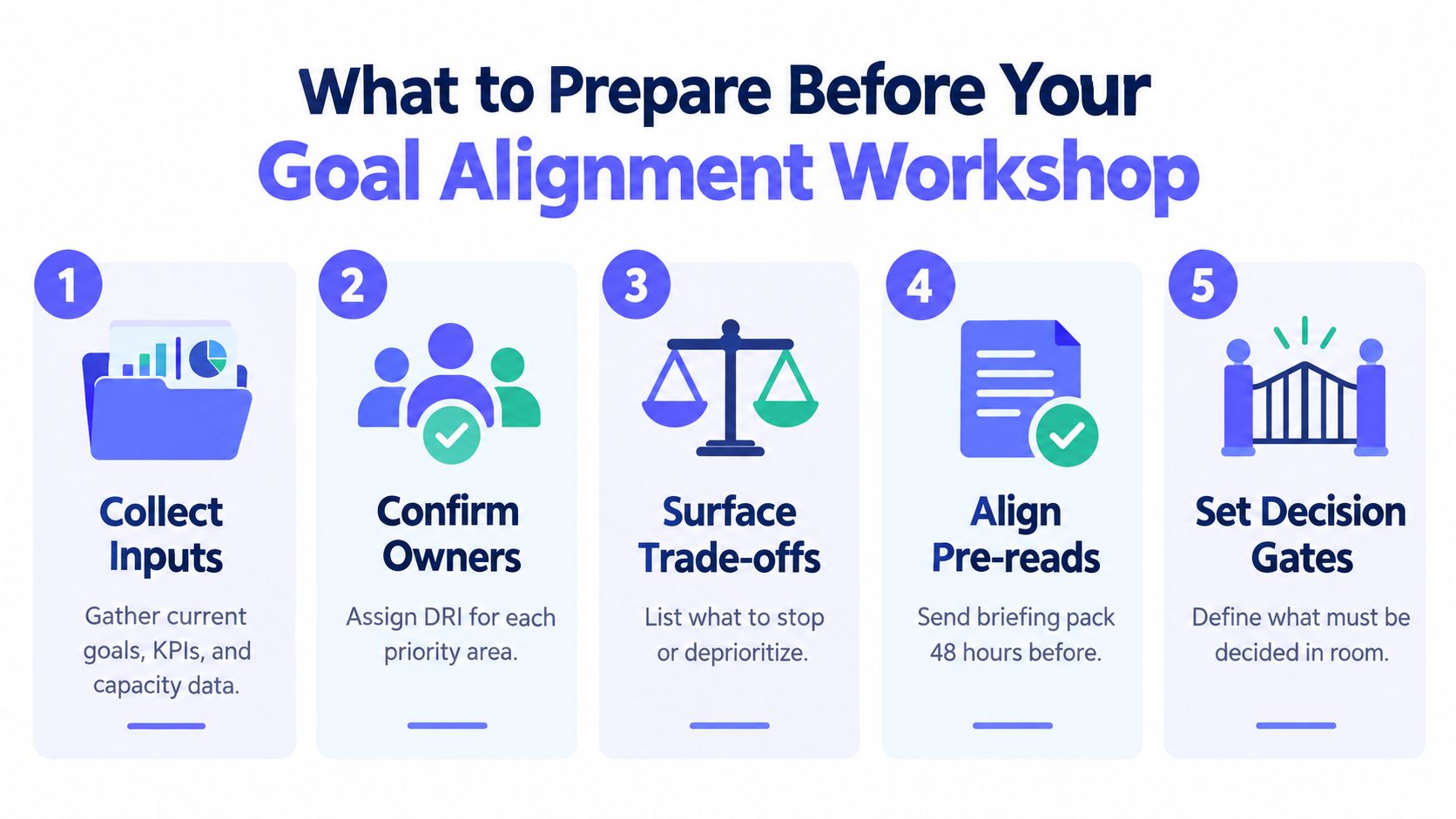
Collect the inputs that constrain execution
Start with a single working pack. Include the current strategy, enterprise priorities, existing team goals, performance measures, known delivery risks, active dependencies and capacity constraints. Add the previous cycle's outcomes where they're reliable enough to inform decisions.
Don't ask participants to arrive with fully formed OKRs. Ask them to bring the evidence and choices behind their proposed priorities. A sales leader should know which growth assumption the team is protecting. An engineering leader should know which platform constraint affects delivery. A people leader should understand where manager capability or workforce experience could limit adoption.
Then map each strategic goal to a named owner. The owner isn't the person who completes every task. They're accountable for keeping the outcome visible, coordinating contributors and escalating decisions when the path is blocked.
Apply hard gates before drafting
Use these tests for every proposed priority:
- Ownership gate: Is one person accountable for the outcome?
- Translation gate: Can each affected team state what the priority means for its work?
- Trade-off gate: Can leaders name what will stop, slow down or receive less attention?
- Measurement gate: Is there a credible measure that distinguishes progress from activity?
- Dependency gate: Are the teams, decisions and resources required for delivery identified?
If a proposal fails one of these gates, keep it in the problem queue. Don't turn it into an OKR because the room wants closure.
A March 2025 survey of 102 UK-based senior leaders examined weaknesses in cascade clarity, shared planning methods, middle-management capability and execution readiness in its analysis of where strategy gets stuck. Those are workshop inputs, not side issues. If managers can't translate a priority, the cascade will fail after the leadership team leaves the room.
Send a pre-read that creates useful tension
Send the pack early enough for participants to challenge assumptions privately. Keep the document short, factual and explicit about the decisions required in the session.
Ask each participant to annotate three points:
- Which priority deserves protection?
- Which commitment conflicts with it?
- Which decision or dependency could prevent delivery?
The facilitator should turn those responses into an opening issue list. That approach moves the room away from abstract agreement and towards specific choices.
A pre-read should not make the workshop feel finished. It should make the unresolved decisions impossible to ignore.
How to Run a Goal Alignment Workshop Agenda That Delivers Decisions
A productive agenda creates movement from context to commitment. It doesn't give every topic equal time. It reserves the most attention for trade-offs, dependencies and decision rights, because those are the points where execution usually breaks.
The following format works as a practical leadership session. Adjust the time available to the number of priorities and functions involved, but protect the sequence.
Frame the outcomes and decision rules
Open by stating what the group must leave with. For example, the outputs might be a ranked set of strategic outcomes, a dependency map, named owners, explicit trade-offs and a first review cadence.
Then establish the rules:
- Evidence before preference: Use performance, customer, capacity and risk information before personal conviction.
- Disagreement is useful: Surface competing interpretations rather than smoothing them over.
- No silent approval: Every owner must confirm what they're accountable for.
- Escalation has a route: Record unresolved issues with a named decision-maker and date.
The facilitator should ask, “What must be true for this priority to succeed?” Capture answers where everyone can see them.
Map and rank priorities
Give participants quiet time to review the strategic inputs and write candidate outcomes independently. Silent generation prevents the first senior voice from setting the frame for everyone else.
Cluster similar ideas, remove duplicates and separate outcomes from initiatives. “Improve customer retention” describes an outcome. “Launch a customer-health dashboard” describes an initiative. Both may matter, but they shouldn't compete for the same place in the hierarchy.
Rank the candidates against agreed criteria such as strategic contribution, customer value, feasibility and urgency. Avoid voting alone. Voting can reveal preference, but leadership still needs to make the trade-off explicit.
Resolve conflicts and dependencies
For every high-priority outcome, ask:
- Which team must contribute?
- What does that team need from others?
- Which commitment could create a conflict?
- What decision is currently blocked?
- What happens if the dependency arrives late?
A dependency map should record the provider, recipient, required contribution, timing assumption and escalation route. Don't let teams describe dependencies as vague collaboration. “Marketing supports product” isn't actionable. “Marketing supplies validated positioning before the product launch decision” gives the relationship a testable condition.
Use a parking lot only for issues that fall outside the room's authority. Everything else needs a decision, an owner or a scheduled escalation.
Commit to owners and measures
Once priorities are stable, assign a single accountable owner to each outcome. Confirm contributors separately. Shared accountability often sounds inclusive but makes escalation ambiguous.
Test every proposed key result with three prompts:
- What will change?
- How will we know?
- What baseline or starting point makes the target meaningful?
The workshop doesn't need to solve every measurement detail, but it must reject activity disguised as evidence. A completed project plan may support an outcome. It doesn't prove that the outcome occurred.
Lock the follow-through
Close by reading back the decisions. The facilitator should name what was prioritised, what was deprioritised, who owns each result, which dependencies remain open and when the first review will happen.
Publish the agreed record quickly. A tracking tool such as a shared workspace, spreadsheet or OKR platform is useful only if it reflects the decisions accurately. The wider question is meeting design. Teams can use the practical guidance on meeting effectiveness to make the follow-up cadence focused rather than adding another recurring status meeting.
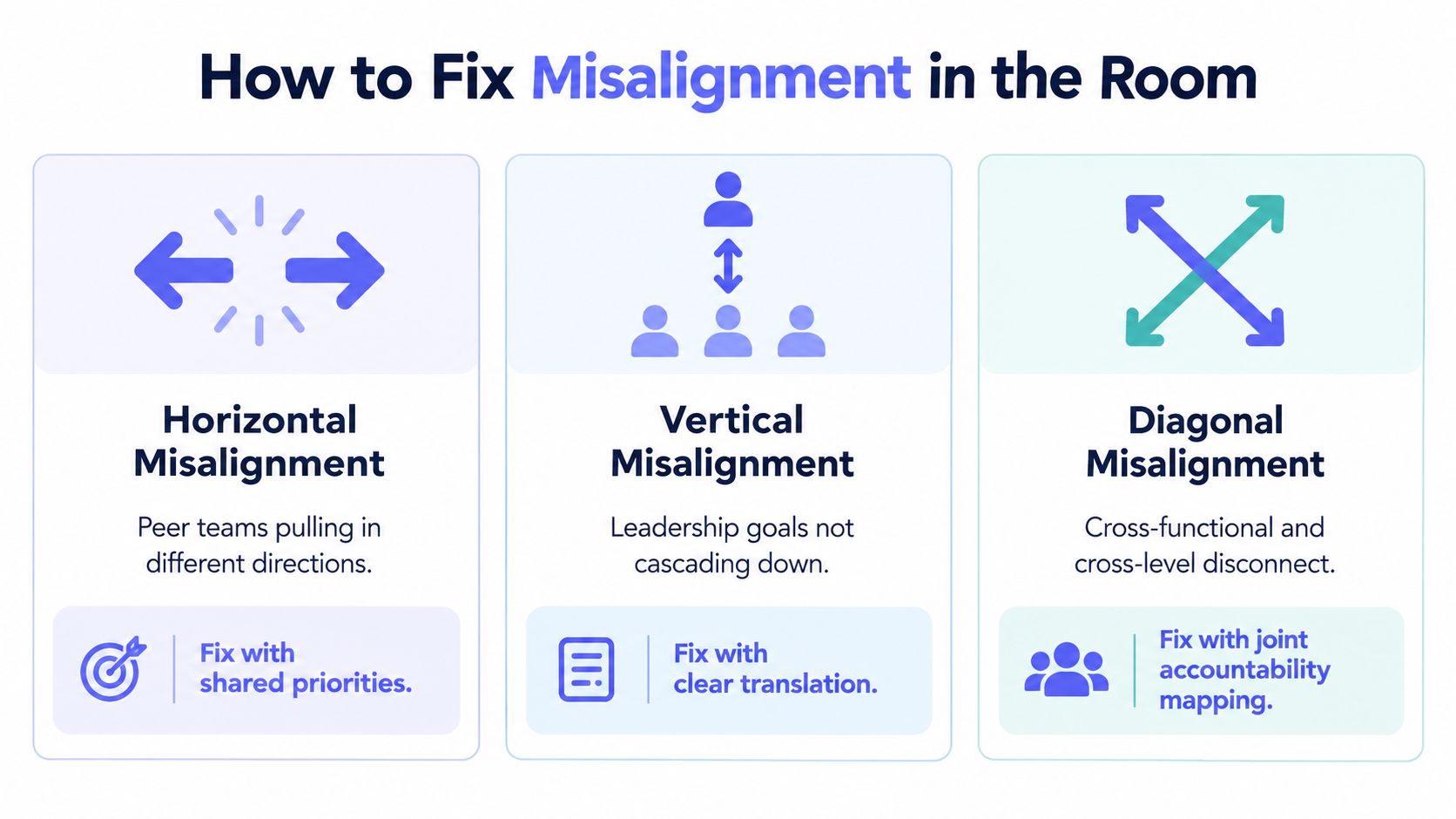
How to Fix Horizontal Diagonal and Vertical Misalignment in the Room
Misalignment has different shapes, so it needs different interventions. A team may agree with the enterprise strategy and still fail to coordinate with peers. A manager may understand the executive message but translate it poorly for their team. Two functions may share a dependency while reporting through different leadership lines, leaving nobody clearly accountable.
UK organisational alignment analysis reported horizontal misalignment affecting 73% of respondents regularly or very often, diagonal misalignment affecting 58% and vertical misalignment affecting 46% in its organisational alignment analysis. A related UK source reports that respondents estimated more than 30% of their time and energy went into dealing with misalignment in its analysis of strategy implementation.
Pass one addresses horizontal friction
Horizontal misalignment appears between peer teams. Product prioritises adoption, sales prioritises a bespoke commitment, and operations protects standardisation. Each choice may be rational locally. Together, they can create contradictory work.
Run a peer dependency review. Put the teams' proposed outcomes side by side and ask where one team's success creates work, risk or delay for another. Resolve the conflict by agreeing the shared outcome, the contribution each team makes and the decision rule when capacity changes.
A useful prompt is, “If both teams hit their local target, what could still go wrong for the organisation?” That question exposes local optimisation without blaming either function. For deeper guidance, leaders can review cross-functional alignment practices.
Pass two checks diagonal translation
Diagonal misalignment cuts across functions and levels. A transformation leader may rely on a finance decision, a technology platform and a frontline manager, none of whom report to the same person.
Map the dependency as a chain. Name the executive sponsor, functional owner, delivery contributor and affected team. Then ask each participant to explain the commitment in their own words. Differences in the answers reveal translation gaps immediately.
Pass three clarifies vertical authority
Vertical misalignment occurs when leadership goals don't become usable team priorities. Executives may announce growth, managers may hear cost control, and teams may receive a list of projects with no clear order.
Run a translation check from enterprise outcome to team action. Every level should be able to state its contribution, its boundary and the decision it can make without escalation. If the answer is “we'll wait for leadership”, the decision rights are incomplete.
A workshop fixes this by recording authority, not just ambition. The final output should show who decides, who advises, who delivers and who needs visibility.
Common Pitfalls That Derail Goal Alignment Workshops and How to Avoid Them
A workshop can produce polished OKRs while leaving the operating system unchanged. Teams then return to conflicting incentives, overloaded capacity and unclear escalation routes. Treat alignment as three passes, horizontal, diagonal and vertical, with hard gates before any OKR receives approval.
Starting with OKR syntax
Writing objectives first feels productive, but it can hide the decision about what the organisation will prioritise. Use syntax only after the underlying alignment is clear. For guidance on common OKR mistakes, start with the operating choices, not the wording.
Set a hard gate. No OKR moves forward until its owner, trade-off, measure and dependencies are visible. If the group cannot answer those questions, record the decision still required instead of accepting vague consensus.
Allowing aspirations without evidence
“Become world class” and “transform the customer experience” express intent, but they do not guide execution. They let teams claim progress without showing what changed.
Ask what would be observably different. If the answer cannot be measured or evidenced, keep the phrase as strategic context and identify the result beneath it.
Treating every commitment as a priority
A leadership team that refuses to stop anything has documented the status quo. Use a stop-doing list. For every new priority, identify the work that loses capacity. If leaders will not make that trade-off, teams cannot reliably deliver the new outcome.
Ignoring behaviour and culture
Strategy may say “enable managers” while leaders continue to bypass them. A company may promote collaboration while rewarding only functional results. Those contradictions can invalidate decisions made in the room.
A 2025 UK survey of more than 1,170 managers and employees found that only 18% said stated values or external image were very aligned with day-to-day culture, while 25% said leader behaviour didn't reflect those values in its organisational culture survey. Ask which behaviours the goals require, then assign leaders responsibility for demonstrating them.
Capability and resource friction need the same scrutiny. A UK strategy and operations evidence review cited financial cost as a significant barrier for 33% of respondents, workforce skills gaps for 25% and access to finance for 24% in its analysis of adoption barriers. A goal without the capability to execute it is a forecast, not a commitment.
Embedding Outcomes and Measuring What Happens Next
The workshop creates alignment once. The operating rhythm has to renew it.
Start by publishing a concise decision record. Include the objective, key results, owner, contributors, dependencies, trade-offs, decision rights and review date. Don't bury those points in a presentation. Teams need a working reference they can use during prioritisation and escalation.
Put the outcomes into existing rhythms
Use weekly or fortnightly team reviews to discuss movement, confidence, blockers and decisions. Keep the conversation outcome-led. “What did we complete?” can be useful, but “What changed in the result, and what will we do if it hasn't moved?” is more diagnostic.
Managers should translate the enterprise priorities in team meetings and one-to-ones. Performance conversations should distinguish outcome ownership from task completion. Governance forums should review cross-functional dependencies, not force every team to provide the same status update repeatedly.
The DBS annual quality account for 2025 to 2026 reported a 65% employee engagement survey response rate, an overall Engagement Index of 69%, an 11-point increase since the survey series began in 2021/22, Wellbeing at 74% and a line manager score of 85% in its annual quality account. These figures reinforce a practical point. Alignment depends on leadership visibility, management quality, decision-making and trust, not on the goal document alone.
Track execution signals
Use a small set of measures:
- Outcome progress: Are key results moving against the agreed baseline and target?
- Confidence: Do owners still believe the outcome is achievable?
- Dependency health: Are other teams delivering the contributions required?
- Decision speed: Are unresolved issues reaching the right decision-maker?
- Translation quality: Can managers and teams explain the priority consistently?
- Behavioural evidence: Are leaders acting in ways that support the stated culture?
The guide to measuring outcomes can help teams separate meaningful progress from activity reporting. Review the measures at the first cadence, not only at the end of the cycle. Early friction is useful if leaders act on it.
For retention and inclusion, include questions about whether people understand the priorities, can influence delivery and have the support required to succeed. The 2025 UK IC Index found that 63% of UK employees said their organisation's values aligned with their own, and aligned employees were more likely to intend to stay for three years or more, 82% compared with 62% in the IC Index 2025. Alignment should help people see a credible connection between organisational direction and their working experience.
The OKR Hub helps leadership teams diagnose misalignment, facilitate priority and dependency decisions, and embed OKRs into operating rhythms through consulting, training and hands-on coaching. Visit The OKR Hub to assess your readiness for a goal alignment workshop and get practical support connecting strategy with measurable delivery.